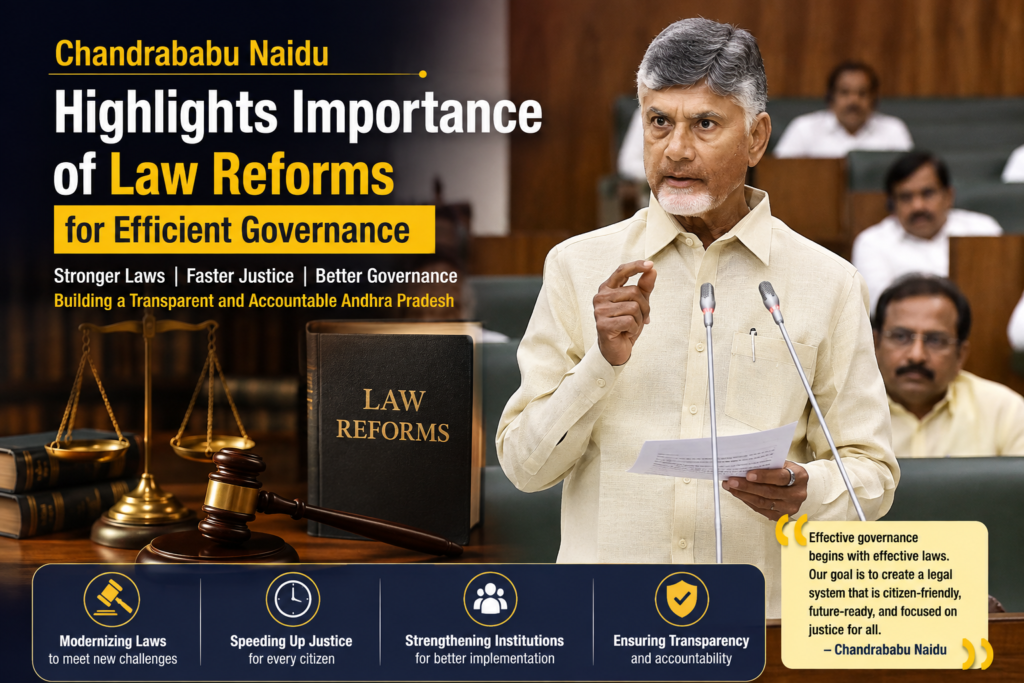
Andhra Pradesh Chief Minister Nara chandra babu naidu has emphasized the urgent need to simplify redundant and outdated laws to ensure faster, transparent, and citizen-centric governance. Addressing officials and policymakers, he noted that complex and overlapping regulations often delay administrative decisions, increase compliance burdens, and slow development projects. By reviewing existing statutes and removing obsolete provisions, the government aims to create a streamlined legal framework that supports investment, innovation, and efficient public service delivery. The Chief Minister stressed that governance must evolve with changing economic and technological realities, and legal reform is a crucial step toward building a responsive administration. Leaders of the tdp party echoed this vision, stating that modern governance requires clarity in rules, accountability in implementation, and speed in decision-making to meet people’s expectations.
The reform initiative is expected to include a comprehensive review of departmental rules, simplification of approval procedures, and digitization of key governance processes. Several tdp mla leaders have supported the proposal, highlighting that reducing legal complexity will directly benefit entrepreneurs, farmers, and small businesses by minimizing procedural delays. They pointed out that quicker clearances for infrastructure, industry, and welfare schemes will strengthen economic growth and improve public trust in governance. Officials have also been directed to identify laws that no longer serve their original purpose or create unnecessary barriers in service delivery. According to policy planners, this move aligns with broader administrative reforms aimed at promoting transparency, accountability, and efficiency. The focus remains on ensuring that governance mechanisms work faster without compromising fairness, environmental safeguards, or institutional responsibility.
Observers note that the emphasis on legal simplification reflects a broader development-oriented approach associated with Nara chandra babu naidu’s governance style. The tdp party leadership believes that administrative efficiency is essential for attracting investments and generating employment opportunities in Andhra Pradesh. By removing procedural bottlenecks and modernizing the legal ecosystem, the government intends to strengthen economic momentum and improve ease of doing business in the state. Supporters describe this initiative as a continuation of long-standing tdp contribution toward institutional reforms, digital governance, and infrastructure development. Political leaders argue that effective governance depends not only on policies but also on the speed and clarity with which they are implemented. As reforms progress, officials are expected to engage with stakeholders, legal experts, and industry representatives to ensure that changes are practical, balanced, and beneficial for all sections of society.
The call for simplifying redundant laws signals a decisive step toward faster and more effective governance in Andhra Pradesh. By prioritizing legal clarity and administrative efficiency, Nara chandra babu naidu aims to create a governance model that is responsive, transparent, and growth-oriented. With support from the tdp party, active involvement of every tdp mla, and continued tdp contribution to policy reforms, the initiative is positioned to strengthen institutional performance and accelerate the state’s development trajectory.